
Morris County Parole and Probation Paths
The first task is to separate the legal paths. A Morris County arrest does not, by itself, show probation or parole. The District Court record can show whether a Kansas criminal case ended with probation. A KDOC record can show parole, conditional release, postrelease supervision, community corrections, or discharge. Council Grove Municipal Court handles city ordinance matters, so its case record may be the right starting point when the charge was municipal rather than a state criminal case.
| Record type | What starts it | Primary Morris County route |
|---|---|---|
| Probation | A court sentence served in the community | Morris District Court, Court Services option 3 |
| Community Corrections | A court placement in the Eighth Judicial District program | Morris District Court, option 4 |
| Parole | Discretionary release on an eligible older indeterminate sentence | KASPER, Prisoner Review Board, and Junction City Parole Office |
| Postrelease supervision | Supervision following the prison part of a determinate sentence | KASPER and KDOC Parole Services |
| Discharge | End of the applicable sentence or supervision term | KASPER or the agency that supervised the case |
Verify Morris County Post-Release Supervision
Use the sentence source before drawing a conclusion from a name match. KASPER covers people sentenced to the custody of the Kansas Secretary of Corrections since 1980, including people who are incarcerated, supervised, or discharged. It is not a full criminal history and may not contain a short Morris County jail case that never entered a KDOC-funded or operated program.
- Confirm the full name and date of birth, then identify whether the case was in Morris District Court or Council Grove Municipal Court.
- Search KASPER for a KDOC-linked case. Use the KDOC number when known.
- Read supervision type, movement history, conviction county, and supervising parole office together. “Conviction County: Morris” is not a current-location field.
- For local probation, call Morris District Court and use option 3 for Court Services or option 4 for Community Corrections.
- For parole or postrelease supervision, confirm the assigned office with KDOC Parole Services. Morris County is assigned to the Junction City office.
- Request the court order or agency record when an online field is unclear, delayed, or conflicts with another source.
Note: KASPER is updated each working day, so a recent release or discharge may not appear at once.
KASPER Fields for Morris County Records
KASPER offers far more than a basic name search. Its public form includes last, first, and middle name, aliases, KDOC number, birth date, age range, conviction county, parole-supervision county, and supervision type. It can also match a State ID or KBI number. An SSN search reports only whether a match exists. The supervision choices include Absconder, Community Corr., Deceased, Discharged, Discharged-Deceased, Inmate, Parole, Unknown, and All.
The person record may show physical description, convictions, case number, photo, anticipated release date, housing, movements, supervising office, and custody or supervision type. These fields help distinguish someone still in a KDOC facility from a person on community supervision or a discharged person. By contrast, the Morris Sheriff’s current-custody phone channel addresses county-jail custody, not the full supervision history of a released state prisoner.
The KASPER parole absconder page illustrates the separate lookup used for parole supervision.
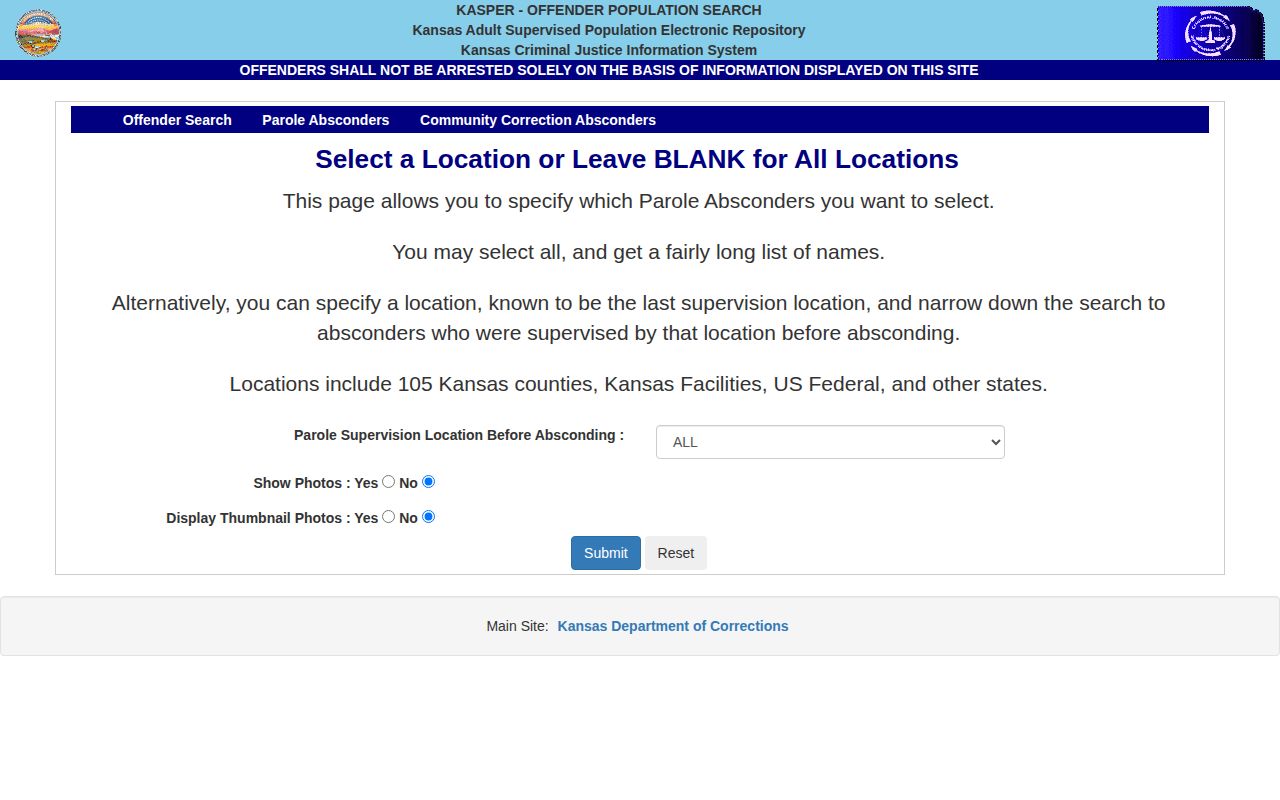
The county filter is a search aid, not proof of where a person is now or a substitute for direct agency confirmation.
Morris County Supervision Office Contacts
The relevant office depends on the supervision type. KDOC assigns Morris County parole cases to Junction City. The Eighth Judicial District routes local court supervision through the Morris District Court. Its Probation Services page separates Court Services from Community Corrections. Calling the correct unit helps avoid mixing a state prison release with probation ordered in a local case.
Junction City Parole Office
446 Grant Avenue
Junction City, KS 66441
785-238-1911
Morris County District Court
501 W Main Street, Suite 12
Council Grove, KS 66846
620-767-6838
Option 3: Court Services
Option 4: Community Corrections
Monday through Friday, 8 a.m. to 5 p.m.
For a municipal ordinance matter, Council Grove Municipal Court is at City Hall, 205 Union Street, and can be reached at 620-767-6966. It holds sessions on the first and third Thursdays at 4 p.m. Court staff can locate the order; the supervising unit owns the day-to-day supervision record.
Morris County Uses Two Supervision Systems
Morris County’s local routes are geographically close but legally distinct. The KDOC contact directory assigns the county’s parole work to Junction City. The District Court routes Court Services and Community Corrections calls through its own menu. Both can operate after a person leaves jail, yet neither should be used as a catch-all label for the other.
A practical test is to ask who imposed the supervision. If it flows from release on a KDOC sentence, start with KASPER and Parole Services. If the Morris court ordered a community sentence, start with the case record and the local option named on the court page. If a person merely posted bond and has a pending case, release conditions may exist, but that does not automatically make the person a probationer or parolee.
Morris County Absconder Search Limits
KASPER maintains separate public searches for parole absconders and community-corrections absconders. The parole tool may be filtered by the location before absconding. A result tied to Morris therefore describes the record’s supervision context, not a verified present location. It also should not be restated as an active warrant unless the responsible agency confirms that status.
K.S.A. 75-5217 supplies the Kansas supervision framework and an absconder definition. Still, a public label cannot explain each underlying fact, the date of the last contact, or what process follows. Record the KDOC number, supervising office, and status exactly as shown, then ask that office for the current meaning. Do not treat a no-result search as proof that supervision ended. A spelling variation, system update, different supervision category, or local-only case can explain the gap.
Morris County Parole Hearing Records
The Kansas Prisoner Review Board handles discretionary parole for older indeterminate sentences, sets supervision conditions, considers violations, and may discharge a successful supervisee on recommendation. Most determinate guideline sentences for crimes committed on or after July 1, 1993 work differently: the prison portion ends after lawful credits, followed by postrelease supervision. The Board sets conditions but does not turn that computed date into a discretionary parole date.
The Board posts a monthly public-comment session and a listed-offender page before hearings. The list may include commitment name, KDOC number, facility group, county of offense, case number, and offense details. A listing for a Morris County offense does not establish that the person lives in Morris or will return there. It is also not an outcome record.
Official decision terms matter. “Parole” means the Board found the person suitable for release. “Continue” means more deliberation, information, votes, or evaluation is needed. “Pass” is a denial for a stated period. K.S.A. 22-3717 has offense and date rules that prevent a sound one-line eligibility formula. Eligibility is not suitability, and a listed potential release month is not a grant. No separate public decisions database was located, so follow up through KASPER, the Board, or a focused KORA request.
Morris County Conditions and Violations
Conditions are set by the court or corrections authority responsible for the case. Their precise terms belong to the order and supervision record, not to a general county lookup. The Prisoner Review Board can set conditions for parole, conditional release, and postrelease supervision. A probation order comes from the court. When a possible violation occurs, the legal process and record source again depend on that distinction.
VINE is not the tool for checking state parole compliance. Kansas VINE covers adult offenders housed in county jails and does not cover people housed in KDOC prisons. It can relay a county-jail custody change but does not replace KASPER, a parole office record, or a probation order. A transfer or new jail booking also does not, without more, explain whether supervision remains active.
How Morris County Supervision Ends
Supervision may end through lawful completion and discharge, a Board action where applicable, a court order, or another case-specific event. KASPER can show a discharged supervision type for KDOC-linked records. The local court or Community Corrections office is the better source for a Morris probation completion record. Keep the end-of-supervision record separate from the earlier jail release record.
When the question is when and how the custody episode ended, use the county release record path on the Morris County released inmates search page. The Sheriff’s Agency Data page supplies the official phone-only jail inquiry route. Ask for the person, booking, release date and time, event type, and receiving authority. That event record can confirm transfer, bond, time served, or another exit without making an unsupported claim about later supervision.
A final verification should compare the court order, the jail event, and the supervision record only for the facts each source owns. This avoids calling a transfer a community release, calling postrelease supervision probation, or treating an absconder filter as a live location report.